
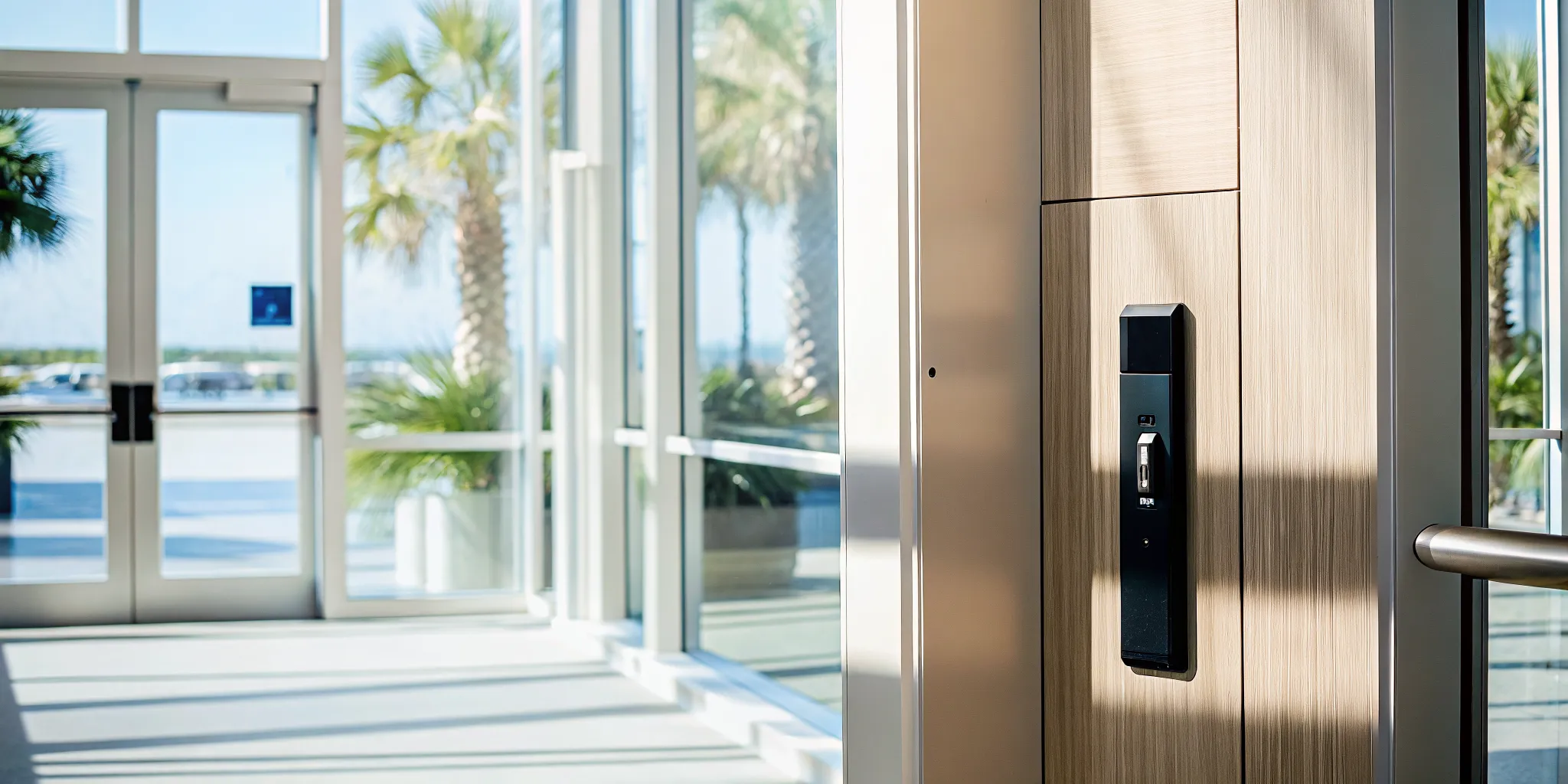
Your building’s security shouldn’t be vulnerable to Florida’s weather or a weak Wi-Fi password. Standard hardware can fail quickly in our coastal humidity, and a networked system without proper cybersecurity is an open door for hackers. The right access control systems for Florida commercial buildings must include hardware with at least an IP65 rating to withstand storms and corrosion. They also require integration into a comprehensive cybersecurity strategy to protect against digital threats. This article outlines the key physical and digital resilience features your system needs to provide reliable security, protecting your assets from both hurricanes and hackers.
Key Takeaways
- Treat access control as a central security hub: A modern system does more than open doors; it integrates with video and alarm systems to give you a complete, real-time view of your facility, turning disconnected alerts into coordinated security responses.
- Match the system to your specific environment: The right choice depends on your unique business needs, from industry compliance rules like HIPAA to the number of entry points you have and the durability required to withstand Florida’s climate.
- Prioritize the provider, not just the product: Your security partner is crucial for long-term success. Choose a local provider who understands cybersecurity, offers responsive support, and can design a system that scales with your company’s growth.
What Are the Main Types of Access Control Systems?
Choosing an access control system isn’t a one-size-fits-all decision. The right solution for your Florida business depends on your specific security needs, the number of entry points you need to cover, and your budget. These systems range from simple key fobs to advanced biometrics, each with its own set of benefits and considerations. Understanding the main types is the first step in securing your facility, whether it’s a single office in Tampa or multiple manufacturing sites across the state. A well-designed system should align with your operational workflow and your overall cybersecurity posture.
Keycard and Key Fob Systems
These are some of the most common systems you’ll see in commercial buildings. Employees are given a physical credential, either a plastic card or a small fob for their keychain, which they present to a reader to unlock a door. They are relatively inexpensive to install and incredibly easy for users to understand. Managing these systems is also straightforward; you can activate or deactivate a specific card from a central computer. The main drawback is that cards and fobs can be lost, stolen, or shared, which can create a security risk until the credential is disabled in the system.
Biometric Access Control
For businesses that require a higher level of security, biometric systems are the gold standard. Instead of a card or a code, these systems use a person’s unique biological traits, like a fingerprint, facial scan, or iris pattern, to grant access. Because these “credentials” can’t be lost, stolen, or shared, they provide maximum security for sensitive areas like data centers, server rooms, or healthcare record storage. While the initial investment is higher than for card-based systems, they eliminate the ongoing cost of replacing lost fobs and provide a clear, indisputable record of who accessed an area and when.
Keypad and PIN Entry Systems
Keypad systems are a simple and cost-effective way to secure an entry point without needing physical keys or cards. Users just type a secret code (a PIN) to unlock the door. This makes them a great choice for low-traffic areas or rooms where security needs are minimal, like a supply closet or a break room. The primary vulnerability is that PINs can be shared, forgotten, or even seen by an onlooker. To maintain security, it’s critical to have a policy for changing codes regularly, especially when an employee with access leaves the company.
Mobile and Remote Access Solutions
Why carry a key fob when you already carry a smartphone? Mobile access control turns an employee’s phone into their credential. Using an app, users can unlock doors with a simple tap, often using Bluetooth or NFC technology. This is incredibly convenient and allows for flexible management. For example, you can grant a contractor temporary access remotely without ever meeting them in person. While this adds a layer of modern convenience, it also means your security relies on employees keeping their phones charged and secure.
Cloud-Based Access Control
A cloud-based system moves the management software from a dedicated server in your office to the cloud. This is a game-changer for businesses with multiple locations, as you can manage access for all your sites from a single web-based dashboard. You can add or remove users, change permissions, and view logs from anywhere with an internet connection. This approach aligns perfectly with a broader cloud migration strategy, offering scalability and reducing the need for on-site hardware. The system’s reliability depends on your internet connection, and it typically involves a monthly or annual subscription fee.
Must-Have Features for a Modern Access Control System
A modern access control system does far more than just lock and unlock doors. It acts as a central nervous system for your building’s security, providing data, flexibility, and control that traditional keys can’t match. When evaluating your options, moving beyond basic keycard functionality is key. The right system should include a core set of features that not only secure your premises but also streamline your operations. These capabilities are what transform an access control system from a simple expense into a strategic asset for your Florida business.
Keyless Entry and Mobile Credentials
Forget worrying about lost keys or expensive re-keying. Modern systems use keyless and mobile credentials, allowing employees to access secured areas with a smartphone app, a key fob, or even biometrics like a fingerprint. This approach significantly improves convenience and security. You can grant or revoke access permissions instantly from a central dashboard, which is perfect for managing new hires, temporary staff, or employee departures. Instead of tracking physical keys, you manage digital credentials that are nearly impossible to duplicate, giving you precise control over who can enter your facility at all times.
Real-Time Monitoring and Instant Alerts
Imagine knowing the second a secured door is forced open or propped ajar. That’s the power of real-time monitoring. A modern access control system gives you a live view of activity across your entire building from a single interface. You can see who is entering and when, but more importantly, the system can send instant alerts to your security team or management for unusual events. This proactive approach allows for an immediate response, turning a potential breach into a quickly managed incident. This level of visibility is a core component of a strong physical and digital cybersecurity posture.
Audit Trails and Activity Logs
In the event of a security incident or even a simple workplace dispute, having a clear record of events is invaluable. Every quality access control system provides a detailed audit trail, logging every single access attempt, whether successful or not. These activity logs show exactly who entered a specific area and at what time, creating a powerful layer of accountability. For businesses in regulated industries like healthcare or finance, these logs are often essential for compliance audits. You can use this data to investigate incidents, review employee movement patterns, and ensure security protocols are being followed correctly.
Remote Management Capabilities
Your ability to manage building security shouldn’t stop when you leave the office. Cloud-based systems offer remote management, allowing you to control access from anywhere with an internet connection via a secure website or mobile app. Need to grant a contractor temporary access while you’re off-site? Or unlock a door for an employee who forgot their credentials? You can do it all from your phone or laptop. This flexibility is essential for business owners and facility managers who need to handle security tasks without being physically present. It’s a key benefit of a well-executed cloud migration for your security infrastructure.
Scalability Across Multiple Entry Points
Your business isn’t static, and your security system shouldn’t be either. Scalability is a crucial feature that ensures your access control system can grow with you. Whether you’re adding a few new doors, expanding to a new floor, or opening another office across Tampa, a scalable system allows you to seamlessly integrate new entry points without replacing your entire setup. This protects your initial investment and ensures a consistent security experience across all locations. When choosing a provider, ask how their system handles expansion to ensure it aligns with your company’s long-term growth plans.
Common Access Control Challenges for Florida Buildings
Choosing an access control system in Florida isn’t just about picking the latest technology. You have to account for our state’s unique environmental and business landscape. From withstanding hurricane season to managing access for multiple tenants in a single building, the right system needs to solve specific, local challenges. Getting this wrong can lead to failing hardware, security gaps, and operational headaches that a generic, off-the-shelf solution simply isn’t prepared to handle.
Humidity, Heat, and Storm-Resistant Hardware
Florida’s heat and humidity are relentless, and the salty air along our coasts can corrode electronic components in record time. A standard indoor-rated card reader might fail within a year or two when installed on an exterior gate in St. Petersburg. You need hardware specifically built to endure these conditions. Look for systems with an IP65 rating or higher, which ensures they are dust-tight and protected from water jets. Hardware made from stainless steel or with special protective coatings offers better resistance to corrosion, extending the life of your investment and ensuring it works when you need it most, even after a tropical storm.
Multi-Tenant User Management
Many commercial buildings in Tampa and Orlando house multiple businesses, each with its own team and security needs. Managing this can quickly become a nightmare with the wrong system. A core challenge is creating a setup where each tenant can manage their own employees without accessing the data of other tenants. A modern, cloud-based platform allows you to partition the system, giving each company administrative control over their own suite while a building manager retains oversight of common areas like lobbies and parking garages. This makes it simple to add or remove hundreds of users instantly when tenants move in or out, a crucial feature for managing varied user groups efficiently.
Legacy System Integration
If your building has been around for a while, you might be dealing with an older access control system. There’s a common myth that upgrading is an all-or-nothing, prohibitively expensive project. That isn’t always the case. Many modern access control controllers can integrate with your existing door hardware and wiring, which can save you 40% or more on installation costs. An experienced provider can perform an audit to see what can be salvaged. A phased approach, upgrading one section of your building at a time, can also make the transition more manageable for your budget. Our IT consulting can help you map out a cost-effective upgrade path.
Cybersecurity Risks in IoT-Connected Systems
Modern access control systems are powerful because they are connected to your network and the internet. However, this connectivity also makes them a target for cyberattacks. A breach could allow an unauthorized person to unlock doors remotely or, even worse, use the access control system as a gateway into your core business network. To prevent this, your system must use end-to-end encryption for all data. It’s also critical to work with an IT partner to implement proper network segmentation, isolating your security devices from the network that handles sensitive business data. This is a key part of a comprehensive cybersecurity strategy that protects all your digital and physical assets.
Integrating Access Control With Your Existing Security
A modern access control system doesn’t operate in a silo. The real power comes from integrating it with the other security and safety systems you already have in place. Think of it as creating a central nervous system for your building’s security. When your access control, video surveillance, and alarm systems communicate with each other, you get a much smarter, more responsive, and comprehensive security posture. This integration turns individual components into a unified defense strategy, giving you a complete picture of what’s happening at your facility at all times. Instead of juggling multiple, disconnected systems, you can manage everything from a single interface, which simplifies operations and strengthens your overall security.
CCTV and Video Surveillance Integration
Connecting your access control system with your CCTV and video surveillance is one of the most effective security upgrades you can make. When these two systems work together, every access event can be linked to a video recording. For example, if an employee swipes their key card at your main entrance, the system can automatically pull up the camera feed for that door. This is incredibly useful for verifying identities and investigating incidents. If an unauthorized access attempt occurs, the system instantly alerts you and provides a live video feed, allowing you to see exactly what’s happening in real time. This integration transforms your access logs from a simple list of names and times into a rich, visual audit trail, providing clear evidence for any security review.
Alarm and Fire Safety System Connectivity
Integrating access control with your building’s alarm and fire safety systems is critical for protecting your people and property. In an emergency, a connected system can perform life-saving actions automatically. For instance, if a fire alarm is triggered, the access control system can instantly unlock designated emergency exit doors to facilitate a swift evacuation, while keeping other areas secure. Conversely, if a door is forced open after hours, the access control system can trigger your building’s security alarm and send an immediate notification to your security provider. This level of automation ensures a coordinated and rapid response when it matters most, creating a safer environment for everyone in your building. It’s a key part of a robust disaster recovery plan.
IT Network and Cybersecurity Alignment
Since modern access control systems are connected to your IT network, they must be treated as part of your overall cybersecurity strategy. An unsecured access control system can become a vulnerable entry point for cyberattacks. Aligning it with your IT security policies is non-negotiable. This means ensuring the system is on a secure, possibly segmented, part of your network, that all software is kept up-to-date with the latest security patches, and that strong credentials are used for administrative access. As a Microsoft Certified Partner, we help businesses integrate these systems securely, ensuring that protecting your physical premises doesn’t inadvertently create a digital backdoor for hackers. Proper integration protects both your building and your sensitive data.
How to Choose the Right Access Control Provider
Selecting an access control system is about more than just hardware; it’s about choosing a long-term security partner. The right provider won’t just sell you a box of equipment. They will work with you to understand your business, assess your property’s unique vulnerabilities, and design a solution that protects your people and assets. A great partner also provides ongoing support to ensure your system runs smoothly and adapts as your business evolves. When you evaluate potential providers, you’re looking for technical expertise, reliability, and a deep understanding of your operational needs.
Your provider should be a key part of your overall security strategy, helping you integrate access control with your existing cybersecurity measures to create a unified defense. As a Microsoft Solutions Partner with over 20 years of experience in the Tampa area, we’ve helped countless businesses navigate this process. To find the best fit for your organization, focus on a few key areas: compliance knowledge, an understanding of your physical space, transparent pricing, scalability, and local support. Breaking down these factors will help you identify a provider who can deliver a system that is both effective and sustainable.
Industry-Specific Compliance Requirements
If your business operates in a regulated industry like healthcare, finance, or law, compliance is non-negotiable. A provider must understand the specific rules you’re bound by, such as HIPAA for protecting patient data or CJIS for handling criminal justice information. Your access control system is a critical component of your compliance strategy, as it documents who accesses sensitive areas and when. Ask potential vendors about their experience with businesses in your industry. They should be able to explain how their proposed system helps you meet and maintain these strict requirements, protecting you from fines and legal trouble.
Building Size and Number of Entry Points
The physical layout of your property dictates the complexity of your access control system. A single-office setup with one main entrance has vastly different needs than a multi-tenant commercial building or a manufacturing plant with dozens of doors, gates, and restricted zones. A qualified provider will perform a thorough on-site assessment to map out all entry points and identify security risks. They can then recommend a solution that covers everything from the front door to the server room. This initial IT consulting and planning phase is crucial for designing a system that is both comprehensive and efficient, without unnecessary hardware or complexity.
Budget and Total Cost of Ownership
While it’s tempting to focus on the upfront price, the true cost of an access control system is its total cost of ownership (TCO). This includes the initial hardware and installation, but also ongoing expenses like software subscriptions, maintenance plans, and potential costs for future repairs or upgrades. A transparent provider will break down all associated costs so there are no surprises. Be wary of unusually cheap systems, as they often come with hidden fees or rely on proprietary hardware that locks you into a single vendor. Investing in a quality system from a reputable provider often leads to lower TCO and better long-term security.
Scalability for Future Growth
Your business isn’t static, and your security system shouldn’t be either. The right access control solution should be able to grow with you. Whether you plan to expand into a larger office, add new locations, or simply hire more employees, your system needs to scale without requiring a complete and costly overhaul. Ask providers how their systems accommodate growth. Modern, cloud-based solutions are often ideal for scalability, allowing you to easily add new doors and users from a central dashboard. Planning for future growth ensures your initial investment remains valuable for years to come.
Local Vendor Support and Service Availability
When a keycard reader fails or a door won’t lock, you can’t afford to wait days for a fix. Having a local provider with a strong support team is essential for minimizing downtime and keeping your facility secure. Look for a vendor based in the Tampa area that can offer quick on-site assistance when you need it most. Before signing a contract, review their service level agreements (SLAs) to understand their guaranteed response times. A reliable partner will offer robust managed IT support and be there to help long after the initial installation is complete.
Comparing Access Control Providers in Florida
Once you know what features you need, the next step is finding a provider to bring your vision to life. The Florida market has a mix of global hardware manufacturers and local service partners. Some companies build the technology, while others specialize in installing and managing it. Understanding the difference is key to finding the right fit for your business. A manufacturer provides the physical locks and software, but a service partner ensures it’s installed correctly, integrated with your other systems, and maintained over time. For most businesses, the ideal solution involves a combination of reliable hardware and expert local support. Here’s a look at some of the top names you’ll encounter and what makes each one unique.
IGTech365
Instead of just selling you a system, IGTech365 acts as your strategic partner. As a Tampa-based managed IT service provider, we integrate access control into your entire technology and security framework. This is a huge advantage for businesses that want a single point of contact for their IT, cybersecurity, and physical security needs. We ensure your access control system communicates securely with your network and that your access logs are protected. For example, we help healthcare clients implement HIPAA-compliant access systems that are managed and monitored as part of their complete managed IT support plan. This holistic approach prevents security gaps between your physical and digital infrastructure.
Genetec
Genetec is known for its powerful unified security platform, which brings access control, video surveillance, and even automatic license plate recognition into a single interface. This is a great option for businesses that want a seamless, all-in-one command center for their security operations. Instead of juggling different software for doors and cameras, your team can manage everything from one place. A Genetec system allows you to link a door access event directly to video footage, making incident investigation much faster and more efficient. Their solutions are highly scalable, serving organizations from a single office to large, multi-site enterprises across Florida.
Honeywell
Honeywell is a globally recognized brand that offers a vast portfolio of access control systems. Their products range from simple, out-of-the-box solutions for small businesses to sophisticated, enterprise-grade systems for complex facilities. A key benefit of choosing Honeywell is the reliability and trust associated with the name. They offer modern features like cloud-based management and mobile credentials that allow employees to use their smartphones as keys. With a wide range of hardware, Honeywell Access Control Solutions can meet diverse needs and budgets, making them a common choice for commercial buildings, healthcare facilities, and industrial sites.
Bosch Security Systems
Bosch is another industry giant praised for its high-quality engineering and reliable security products. Their access control systems are designed for durability and ease of use, with a strong focus on integration. Bosch systems work seamlessly with their own video surveillance and intrusion alarm products, creating a cohesive security ecosystem. This is ideal for businesses that want to build a robust, interconnected security infrastructure from a single manufacturer. For a Florida business, the durability of Bosch Security Systems hardware is a significant plus, ensuring performance even in demanding environments like manufacturing plants or coastal properties.
Avigilon
Avigilon, a Motorola Solutions company, stands out for its heavy investment in artificial intelligence. Their access control systems are tightly integrated with some of the most advanced video analytics on the market. This allows for proactive security measures, such as automatically flagging a door that was forced open and sending a real-time video clip to security personnel. An Avigilon system can help your business move beyond simple entry and exit logs to gain intelligent, actionable insights from your security data. This makes them a strong choice for organizations that need to protect high-value assets or monitor large areas with a high degree of accuracy.
Related Articles
- Information Security vs Cybersecurity: An Important Difference | IGTech365
- The Essential SOC 2 Compliance Checklist | IGTech365
- The 8 Best Remote Computer Access Software Tools | IGTech365
- What is System Administration? – IGTech365 – Tampa Managed IT Services
Frequently Asked Questions
How much should I expect to pay for an access control system? The cost varies quite a bit because it depends entirely on your specific needs. Key factors that influence the price include the number of doors you need to secure, the type of hardware you choose (a simple keypad is less expensive than a biometric scanner), and the software management model. Some systems have a higher upfront cost for hardware and a one-time software license, while cloud-based systems often have lower initial costs but include a monthly subscription fee. The best approach is to think about the total cost of ownership, which includes installation, maintenance, and any ongoing fees, not just the initial price tag.
I have an old keycard system. Do I have to replace everything to upgrade? Not necessarily, and this is a common concern. In many cases, a modern access control system can work with your existing door locks, wiring, and power supplies. A good provider will start with a thorough audit of your current setup to see what can be reused. This approach can significantly reduce installation costs and project time. Upgrading the “brains” of the system (the controllers and software) while keeping the existing door hardware is often a very cost-effective way to get modern features like mobile access and remote management.
Can my access control system be hacked, and how do I prevent it? Yes, any device connected to your network is a potential target for a cyberattack. However, you can take clear steps to protect it. The most important step is to treat your access control system as a critical piece of your IT infrastructure, not just as building hardware. This means ensuring all communication between the readers, controllers, and servers is encrypted. It’s also wise to work with an IT-focused security partner who can properly segment your network, isolating the security system from the network that handles your sensitive business data. Regular software updates are also essential to patch any newly discovered vulnerabilities.
What’s the difference between a cloud-based system and a traditional on-site one? The main difference is where the management software lives. A traditional on-site system requires a dedicated server in your office to run the software, and you typically need to be on-site to manage it. A cloud-based system hosts the software online, so you can manage it from anywhere using a web browser or mobile app. For most businesses, especially those with multiple locations, cloud systems offer greater flexibility, scalability, and convenience, since you can add users or unlock doors remotely without needing to be physically present.
Why is it so important to connect my access control system to my security cameras? Connecting these two systems turns them from passive recording tools into a proactive security solution. When integrated, an event from your access control system, like a door being forced open, can automatically trigger your cameras to start recording and send an alert with a video clip directly to your phone. It also allows you to link every access event to video evidence. If you need to review who entered a specific room at a certain time, you can simply click on the event in the access log and instantly see the corresponding video footage, which makes investigations much faster and more conclusive.