
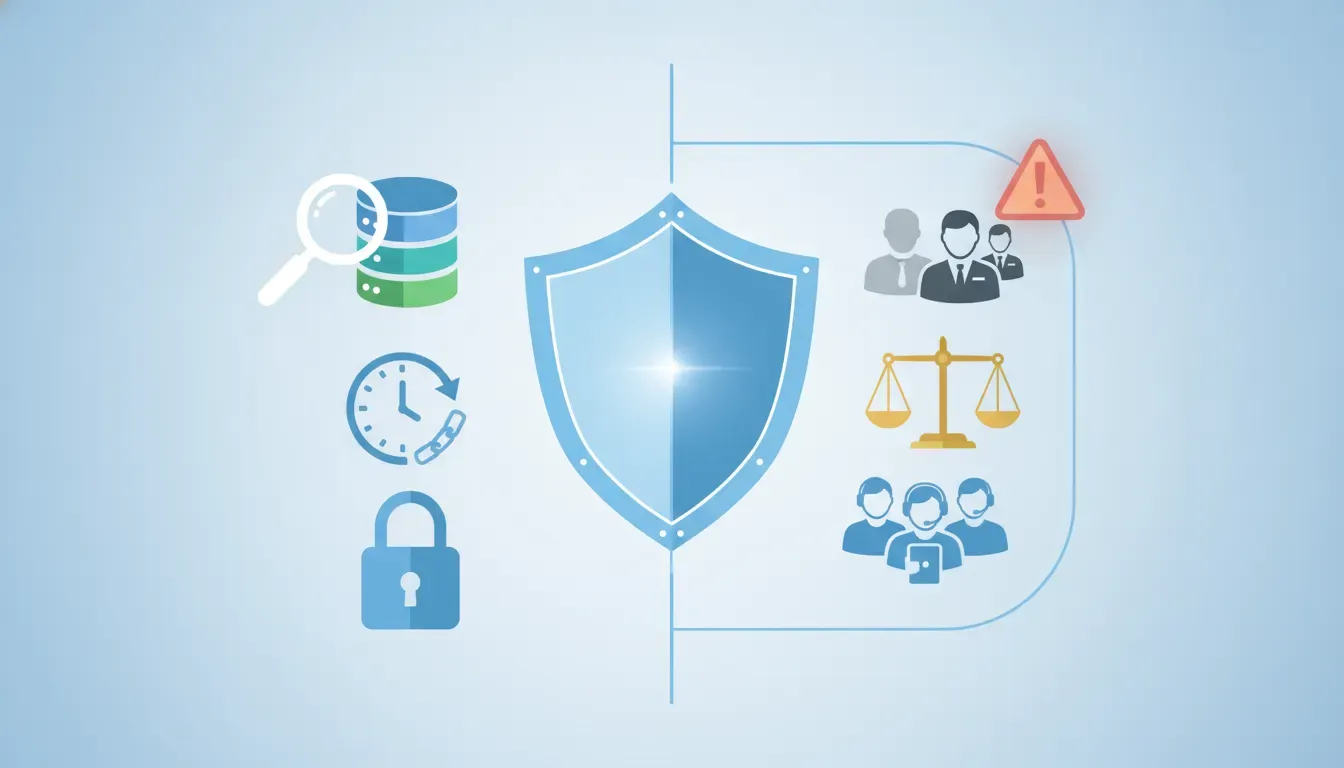
What does cyber insurance cover? In broad terms, a cyber policy can help pay for your business’s own response and recovery costs after a covered cyber event, as well as certain claims brought by customers, partners, regulators, or other third parties. Depending on the policy, that can include forensic investigation, legal counsel, notification, data restoration, business interruption, cyber extortion, and liability defense. It does not replace cybersecurity, and the policy wording, limits, retentions, endorsements, and exclusions determine what the insurer will actually pay.
Talk with IGTech365 about cybersecurity readiness before you rely on a policy to fill gaps in your risk plan.
What does cyber insurance cover for a business?
Cyber insurance generally has two coverage sides. First-party coverage addresses the policyholder’s direct costs after a covered event. Third-party coverage addresses liability when another person or organization claims that the business caused harm through a privacy or security failure.
The distinction matters because a ransomware event can create both types of loss. Restoring systems and replacing data may be first-party expenses. A customer lawsuit or regulatory response may fall under third-party liability coverage. A policy can include both, but the limits and conditions may be different for each section.
First-party coverage: costs your business incurs
First-party coverage may help with expenses such as:
- Incident response and forensics: investigating how an attacker entered, what systems were affected, and whether data was accessed.
- Legal and notification support: determining notification duties, communicating with affected people, and providing call-center or credit-monitoring services when included.
- Data and system recovery: restoring or replacing damaged, encrypted, or stolen business data and rebuilding affected systems.
- Business interruption: addressing lost income or extra operating expense when a covered incident disrupts normal operations.
- Crisis management: public-relations and communications support intended to help the business respond responsibly.
- Cyber extortion: certain costs associated with a ransomware or extortion event, subject to the policy’s definition, consent requirements, and exclusions.
- Computer fraud or funds transfer fraud: losses from certain deceptive transfers, if the policy includes the right fraud or social-engineering coverage.
The Federal Trade Commission’s cyber insurance guidance, developed with the National Association of Insurance Commissioners, identifies many of these first-party costs. Treat the list as a discussion guide, not a promise that every policy includes every item.
Third-party coverage: claims made against your business
Third-party coverage may help when a customer, employee, business partner, or regulator alleges that your organization mishandled data or caused harm through a security failure. Depending on the policy, it may cover:
- Defense costs for lawsuits and certain regulatory investigations.
- Settlements, judgments, or other damages that the policy treats as covered.
- Consumer claims and notification-related liability.
- Costs connected with responding to privacy or security allegations.
- Some claims involving defamation or intellectual-property injury arising from a covered cyber event.
Ask whether the policy provides a duty to defend or only reimburses approved costs. Also confirm who selects legal counsel, which vendors may be used, and whether the insurer’s consent is required before the business admits liability, pays a settlement, or begins certain response work.
Which cyber incidents can a policy respond to?
Coverage depends on the policy’s defined terms, but businesses commonly ask about these scenarios:
- Ransomware: encryption, extortion demands, restoration, investigation, and interruption may involve several coverage sections. Ransom payments, negotiation services, and related expenses can have special conditions or sublimits.
- Data breach or privacy event: a stolen laptop, compromised database, exposed cloud storage, or unauthorized access may trigger investigation, legal, notification, and liability costs when the policy definition is met.
- Business email compromise: an account takeover can lead to fraudulent invoices or transfers. Do not assume this is covered under a general cyber section. Ask specifically about social-engineering, computer-fraud, and funds-transfer provisions.
- Vendor or cloud-provider incident: a supplier’s security failure can disrupt your business or expose your data. Confirm whether the policy includes dependent business interruption and vendor-held data.
- Network interruption: lost revenue and extra expense may be covered when the interruption follows a covered security failure. A routine technology outage may be treated differently.
- Malware or unauthorized access: investigation, recovery, and liability may be available when the event meets the policy’s definition of a security or privacy failure.
Geography, affected systems, the date the incident began, and the relationship between the event and the claimed loss can all matter. A business should report a suspected incident promptly through the policy’s approved channel rather than waiting to decide whether the loss is large enough to justify notice.

What should a business confirm before buying cyber insurance?
Do not compare policies by premium alone. Use this checklist with a licensed insurance professional and your IT or security provider:
- Coverage triggers: Ask how the policy defines a security failure, privacy event, system failure, dependent system, data breach, and cyber extortion. Similar-sounding terms can produce different outcomes.
- First-party and third-party limits: Confirm the total limit, sublimits, retention, waiting period, and whether business interruption uses a time deductible. Check whether incident response costs reduce the overall limit.
- Covered data and systems: Identify whether the wording reaches employee and customer information, cloud applications, company-owned devices, operational technology, backups, and data held by vendors.
- Business interruption measurement: Confirm how lost income, extra expense, restoration time, and dependent business interruption are calculated. Ask what records the insurer will need to support a claim.
- Response providers and consent: Review the breach hotline, approved forensic firms, counsel panel, notification vendors, and any requirement to obtain consent before incurring costs.
- Fraud and social engineering: If employees can approve payments by email, ask for the exact coverage and conditions for fraudulent transfer losses. MFA on email is important, but it does not by itself answer the policy question.
- Vendor and supply-chain events: Ask whether the policy covers an incident at a cloud, payroll, accounting, hosting, or other technology provider and how the policy treats your vendor contracts.
- Exclusions and security warranties: Read exclusions for prior knowledge, war or state-backed activity, unpatched vulnerabilities, unsupported software, failure to maintain controls, and contractual or regulatory penalties. The exact wording controls.
- Territory and notification: Confirm where an incident can occur, where the affected people can live, which law applies, and how quickly the insurer must be notified.
- Policy coordination: Ask how the cyber policy interacts with crime, property, errors and omissions, general liability, and crime-fraud coverage. Look for gaps and overlapping conditions instead of assuming another policy will respond.
For Florida businesses with remote staff, multiple locations, or regulated data, the vendor, cloud, and notification questions deserve special attention. A policy that looks broad on a summary page can be narrower once a specific system, event, or loss is examined.
Review your security controls with IGTech365 to identify practical gaps before an insurance application or renewal makes them urgent.
What does cyber insurance not cover?
Cyber insurance is not an all-purpose technology warranty. Policies commonly limit or exclude some combination of the following, but the wording varies:
- Known incidents or prior knowledge: a problem that began before the policy period or was known but not disclosed may not qualify as a new covered event.
- Failure to meet stated controls: an application, warranty, or endorsement may require the business to maintain particular safeguards. Misstating a control or failing to maintain it can create a coverage dispute.
- Ordinary technology problems: hardware failure, routine maintenance, a non-malicious outage, or an error without a covered security event may belong under another service contract or policy.
- Unapproved response costs: the insurer may require prompt notice, approved vendors, or consent before certain expenses are incurred.
- Some fines, penalties, contractual losses, and illegal payments: whether these are insurable depends on the policy and applicable law. Never assume that a fine or ransom payment will be reimbursed.
- War, terrorism, or state-backed activity: these clauses are highly policy-specific and have received close attention as cyber events become more complex.
- Excluded systems or data: industrial control systems, unencrypted devices, vendor data, or older unsupported systems may receive different treatment.
The safest answer to an exclusion question is not a generic yes or no. Ask the broker to show the exact insuring agreement, exclusion, exception, and endorsement that applies to your scenario. Have counsel review the policy when the risk or contract requires legal interpretation.
How can a business prepare for underwriting and a cyber claim?
A strong application starts with evidence, not just a yes-or-no answer. Build a short security evidence folder that an authorized IT or security lead can maintain:
- An inventory of users, devices, critical applications, cloud services, and sensitive data.
- Proof that multi-factor authentication protects email, remote access, privileged accounts, and other high-risk systems.
- Backup schedules, retention settings, offline or isolated copies, and records showing that restores have been tested.
- Endpoint protection, patching, vulnerability management, and network access-control records.
- A written incident-response plan with roles, escalation contacts, insurer notification steps, and an exercise or review date.
- Employee security training records and a process for reporting suspicious messages or activity.
- Vendor due-diligence records, contracts, and a list of third parties that store or process sensitive information.
The CISA Cross-Sector Cybersecurity Performance Goals provide a useful public reference for prioritizing baseline practices such as MFA, patching, secure configuration, backups, and security awareness. They are not a cyber insurance policy and do not guarantee coverage, but they can help a small business organize its improvement plan.
Before submitting an application, reconcile the answers with the actual environment. If the form says every administrator uses MFA but one legacy account does not, correct the gap or disclose it rather than relying on an optimistic answer. Accurate documentation protects the application and gives the response team a clearer starting point when an incident occurs.
Get practical cybersecurity guidance before you apply from the IGTech365 team serving businesses in Tampa Bay and across Florida.
Frequently asked questions about cyber insurance coverage
Does cyber insurance cover ransomware?
It may cover parts of a ransomware event, such as forensics, legal response, restoration, interruption, and extortion-related services, when the event meets the policy definition. Ransom payments and negotiation costs can have separate limits, exclusions, consent rules, and legal restrictions. Confirm the wording before an incident occurs.
Does cyber insurance cover a data breach?
Many cyber policies address data-breach response costs and related liability, including investigation, legal guidance, notification, and certain claims. The policy must apply to the affected data, system, event, and jurisdiction. Ask how vendor-held data and regulatory response are treated.
Does general liability insurance cover cyber incidents?
Do not assume it does. Traditional policies and cyber policies serve different purposes, and a general liability policy may exclude or limit modern privacy and network-security losses. Ask your insurance professional to review the policies together and identify any gap.
Is cyber insurance worth it for a small business?
That depends on the information you hold, how dependent you are on technology, your contractual obligations, and your ability to fund response and recovery costs. A small business can still face major disruption from a compromised email account, unavailable systems, or a vendor incident. Compare the policy’s coverage and conditions with your realistic recovery plan, not just the premium.
What cybersecurity controls should a business confirm before applying?
Start with MFA for high-risk access, tested and protected backups, endpoint protection, timely patching, vulnerability management, incident-response procedures, employee training, and vendor oversight. Confirm that the controls are actually deployed across the environment and that you can produce supporting records. Requirements vary by insurer and risk profile.
Cyber insurance can transfer part of the financial risk of a covered event, but it works best alongside documented prevention, detection, response, and recovery practices. If you want to compare your current controls with the questions an insurer may ask, contact IGTech365 about cybersecurity support or call (866) 365-7798.