

PCI certification is a common phrase, but the Payment Card Industry Data Security Standard (PCI DSS) is not a government license or a single certificate that applies the same way to every business. It is a set of security requirements for organizations that store, process, or transmit payment card data. The right scope and validation steps depend on how your business accepts payments and which systems touch account data.
Discuss your payment security needs
What do PCI compliance requirements cover?
PCI DSS establishes technical and operational controls intended to protect payment account data. The PCI Security Standards Council describes the standard as applying to environments where payment account data is stored, processed, or transmitted. That means a business should begin by understanding the flow of payment data, not by assuming that only the checkout device matters.
For example, a card transaction might involve a point-of-sale terminal, a payment application, a workstation used by staff, a network connection, a service provider, and records retained for reconciliation. The exact boundary will vary. A system can be relevant because it handles account data directly or because it can affect the security of systems that do.
PCI DSS groups requirements into areas such as maintaining secure systems and networks, protecting account data, managing vulnerabilities, restricting access, monitoring activity, and supporting security policies. The PCI Security Standards Council overview is a useful starting point for understanding the purpose and scope of the standard. Businesses should use the applicable current standard and validation instructions rather than relying on an old checklist or a generic summary.
Who needs to consider PCI DSS?
Any organization that accepts payment cards should determine its obligations with its acquiring bank, payment brand, or other relevant parties. The standard applies based on the handling of payment data, not on whether a business is large or small. A smaller organization may have a simpler environment, but it still needs a defensible understanding of how payments are accepted and protected.
Outsourcing payment processing can reduce the systems that directly handle card data, but it does not automatically remove every responsibility. A business may still have to secure its own devices and network, manage access to payment services, oversee service providers, and complete the validation requested by its payment partners. Confirm those obligations instead of assuming a vendor has taken them all on.
| Payment setup | What to map | Questions to resolve |
|---|---|---|
| Hosted checkout or payment link | Staff devices, browser use, account access, and any data retained locally | Does the business receive or store card data outside the hosted service? |
| Standalone payment terminal | Terminal connection, network segment, vendor access, and update process | Can other business systems reach or administer the terminal? |
| Integrated point-of-sale system | Terminals, POS software, supporting computers, network, and service providers | Which components can affect payment-data security? |
| Business stores or processes card data | Every system, user, transfer, and retention location in the data flow | Is storage necessary, authorized, protected, and limited? |
How can a business identify its PCI scope?
Scope is the practical starting point because it determines which people, systems, and processes must be considered. Create a simple payment-data flow before choosing controls or filling out a questionnaire. This exercise also helps separate a processor’s responsibilities from the controls your business must operate.
- List payment channels. Include in-person terminals, online checkout, phone payments, invoices, recurring billing, refunds, and any other route used to accept cards.
- Trace the data. Record where account data enters, where it travels, which providers handle it, and whether any business system receives or stores it.
- Identify connected systems. Note networks, workstations, administrative accounts, remote access, wireless connections, and vendor connections that could affect payment systems.
- Identify people and processes. Document who can use terminals, issue refunds, change settings, access reports, or respond to a suspected problem.
- Confirm provider responsibilities. Obtain current documentation from payment processors and service providers. Clarify which controls they operate and which remain yours.
- Validate the boundary. Review the map with your acquiring bank or qualified PCI professional, and confirm the requested validation method.
A useful map names systems and owners rather than using broad labels such as “the office network.” If a terminal is connected to a shared network, for instance, document the connection and determine whether separation is possible and properly maintained. Do not declare a system out of scope merely because it is inconvenient to assess.
What practical steps help meet the requirements?
The specific controls depend on your environment and applicable validation instructions. These work areas give a business a practical way to organize its effort:
- Use secure configurations. Change default passwords, remove unused services, and keep payment systems configured according to vendor and applicable standard guidance.
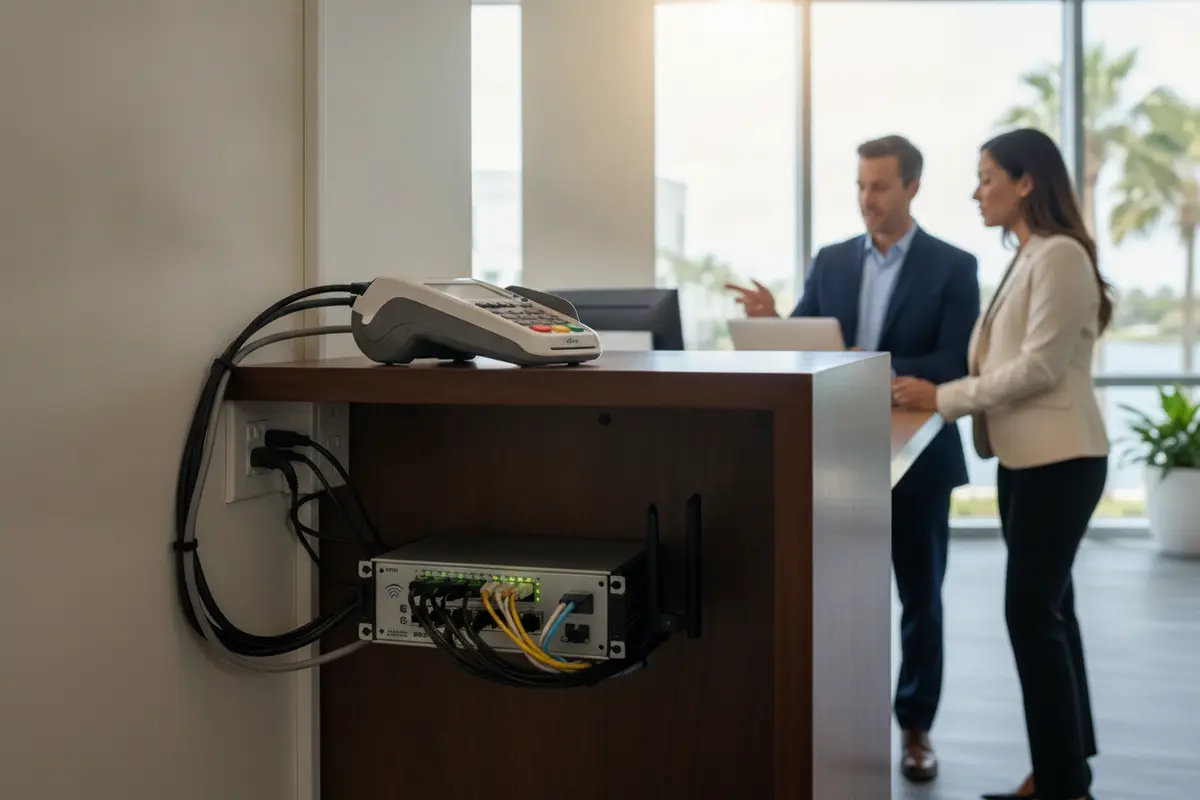
- Protect networks. Restrict unnecessary connections, separate payment systems where appropriate, and document firewall and access rules. Review wireless networks and remote administration paths as part of the same exercise.
- Limit account-data retention. Keep only information needed for a legitimate business purpose and follow the applicable rules for protection and disposal. Never collect sensitive authentication data without confirming the rules and permitted use.
- Manage access. Give users only the access they need, use unique accounts where supported, remove access promptly when roles change, and protect administrative credentials.
- Maintain devices and software. Track payment-related assets, install supported updates, and address vulnerabilities through a documented process.
- Monitor and review. Retain and review relevant security records, investigate unexpected activity, and periodically verify that controls still work.
- Train staff. Explain safe payment handling, phishing risks, incident reporting, and what employees must never write down or send through unapproved channels.
- Document responsibilities. Keep policies, diagrams, provider records, training evidence, and the results of security checks together for review.
For many small businesses, a sensible first improvement is to reduce unnecessary exposure: avoid storing card data, use approved payment channels, remove shared administrative access, and clarify which network devices support payment operations. These changes can simplify the environment, but they do not replace a formal scope and validation decision.
It is also useful to establish an exception process. If a device cannot be updated promptly or a payment workflow must temporarily operate differently, record the reason, the owner, the compensating protection, and the date for review. An undocumented exception can become a permanent weakness that no one remembers to revisit.
How should a business prepare its evidence?
Good evidence connects a requirement to an observable activity. Instead of keeping a folder of disconnected screenshots, organize records by control area and identify the system, responsible person, review date, and result. The format can vary, but someone outside the day-to-day process should be able to understand what was checked and what happened next.
Useful records may include an asset inventory, a current network or payment-flow diagram, access reviews, change records, vulnerability and update reports, approved configuration standards, security-log reviews, incident procedures, staff training records, and service-provider agreements. Keep evidence current. A policy written several years ago does not show that today’s payment environment is configured or monitored as described. Make each record easy to interpret by adding a short note about its purpose and any follow-up. For example, an access review should identify the accounts checked, who approved continued access, which permissions changed, and when those changes were completed. A network diagram should show its revision date and the person responsible for updating it. If a check finds a gap, retain the issue, assigned owner, target date, and proof of closure together. This turns evidence into a working record rather than a collection assembled only when a questionnaire is due.
Set a review calendar that matches the applicable validation instructions and the pace of business change. Revisit the scope after a new point-of-sale system, payment provider, office network, remote-access method, or business process is introduced. This is where an overview of PCI compliance can provide background, while your payment partner determines the obligations that apply to your environment.
Which validation approach should you expect?
Validation is not identical for every merchant. The required self-assessment questionnaire, evidence, or other assessment depends on factors such as payment methods, transaction processing, and instructions from the acquiring bank or payment brands. Some organizations may need an assessment by a qualified assessor. Do not select a questionnaire based only on a vendor suggestion or a search result.
Ask your acquiring bank or payment partner, in writing, which validation route applies, what deadline applies, and what evidence they expect. If you use a service provider, ask for current documentation relevant to the service and clarify your shared responsibilities. Keep the response with your scope notes so the organization can explain why it followed that route.
What common mistakes create avoidable problems?
- Treating PCI as a one-time certificate. Security and payment arrangements change, so scope and controls require periodic review.
- Assuming outsourcing removes all duties. The merchant can retain responsibilities for its environment and provider oversight.
- Using an outdated questionnaire. Confirm the applicable current version and process with the payment partner.
- Forgetting secondary payment paths. Phone orders, refunds, emailed details, and staff workarounds can create unplanned handling of account data.
- Marking controls complete without evidence. Keep records that show who performed a check, when it occurred, and what was corrected.
- Confusing a scan with full compliance. A technical scan can be one input; it does not by itself establish that every relevant requirement is met.
- Ignoring incident preparation. Staff should know how to report suspected misuse, preserve relevant information, and contact the right internal and external parties without improvising.
Routine technology management can support parts of this work, including asset tracking, access management, patching, backup, and security monitoring. Learn more about managed IT services and how an IT team can help keep controls organized. IGTech365 also provides cybersecurity services that businesses can consider as part of a broader security program; a service provider cannot promise that an organization is compliant without the right assessment and evidence.
Businesses using Microsoft tools may also want to review their access and account protections. IGTech365’s Microsoft 365 services can be relevant to user and device administration, while Microsoft 365 licensing and servicing addresses another part of managing that environment. These tools do not substitute for defining PCI scope or confirming payment-specific obligations.
Network design is another area worth examining when payment devices share office infrastructure. The network security resources on this site offer related guidance, but the appropriate segmentation, access rules, and monitoring decisions should be based on the actual payment flow and current validation requirements.
Businesses that need a broader review can also compare their controls with the practical guidance in secure remote-work practices. Remote access is not automatically part of every payment environment, but it can affect systems and accounts that support payment operations.
Frequently asked questions
Is PCI certification an official government license?
No. “PCI certification” is often used informally, but PCI DSS is an industry security standard. Your payment partners determine the validation they require for your business.
Does a small business have to follow PCI DSS?
A business that accepts payment cards should determine its obligations regardless of size. The scope and validation process may differ, so confirm the applicable instructions with your acquiring bank or payment partner.
Does using a third-party processor make my business compliant?
Not automatically. A processor may handle some payment functions, while your organization retains duties for its own systems, users, configuration, and provider oversight. Ask for a clear responsibility breakdown.
Can a vulnerability scan prove compliance?
A scan may be required or useful in a particular validation process, but it does not demonstrate that every applicable control is in place. Follow the full assessment instructions for your situation.
Call to discuss your IT security needs
What should you do next?
Start with a current map of payment channels, systems, data flows, service providers, and responsible owners, then confirm your scope and validation path with the appropriate payment partner. A clear inventory gives your business a practical foundation for prioritizing safeguards, responding consistently to change, and keeping useful evidence.