
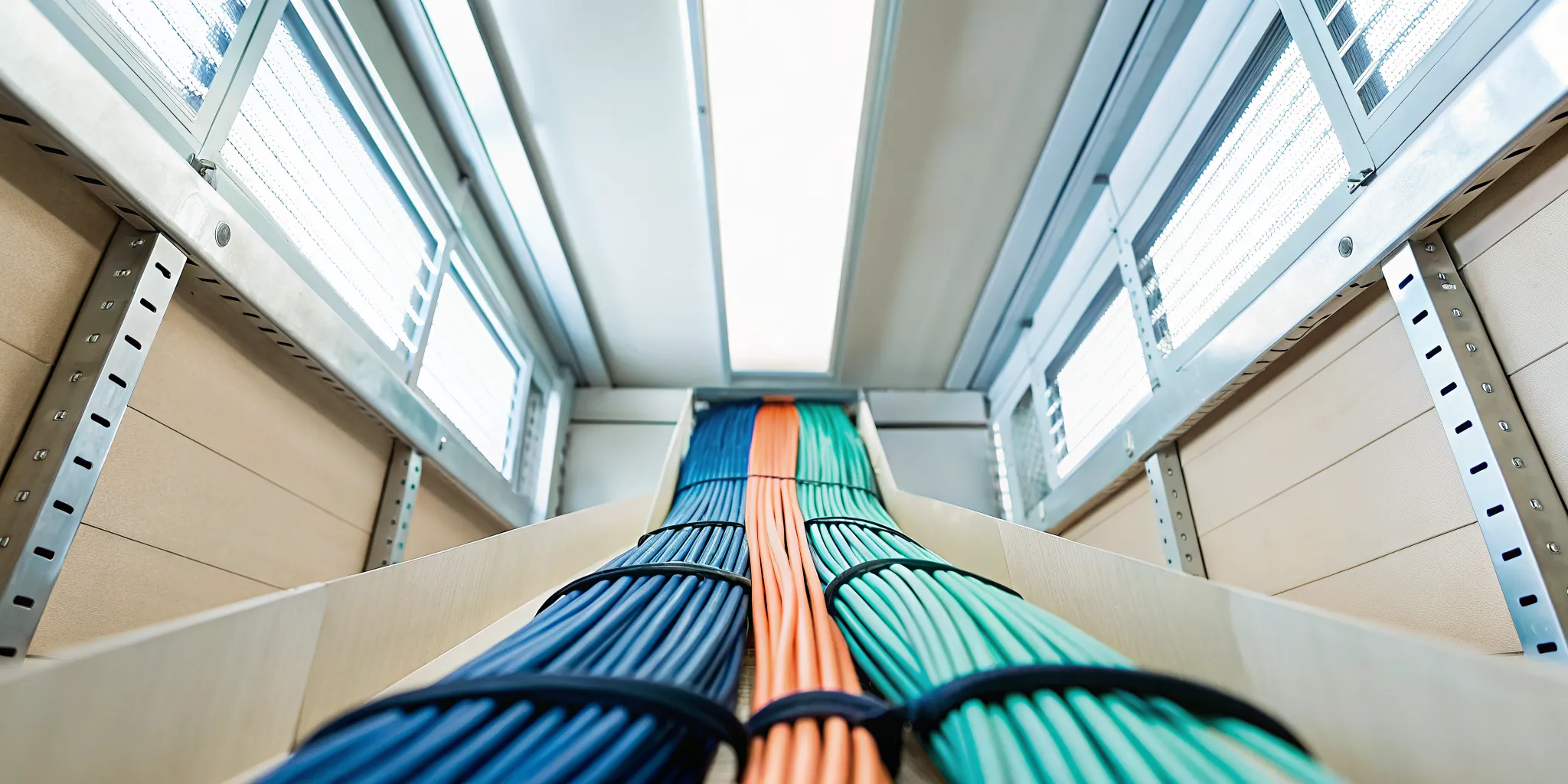
Take a look behind your server rack or along the pathways on your factory floor. Do you see a tangled mess of wires, a “spaghetti monster” that makes troubleshooting nearly impossible? This chaos is more than just an eyesore; it’s a direct cause of intermittent connection drops and extended outages. A structured cabling system replaces this disorganization with a planned, methodical layout. By implementing Manufacturing Facility Network Cabling Best Practices, you can reduce troubleshooting time by up to 90%, turning a multi-hour diagnostic nightmare into a 15-minute fix. This involves meticulous labeling, color-coding, and creating detailed documentation that provides a clear roadmap of your entire network. This article will walk you through the steps to transform your chaotic wiring into an organized, high-performance system that simplifies maintenance and supports your operational goals.
Key Takeaways
- Plan Before You Pull: A detailed cabling blueprint is your best defense against future network problems. Account for your facility layout, separate power and data lines, and plan for device growth to build a scalable and easy-to-manage infrastructure.
- Match Cables to the Environment: Standard office cables will fail on a factory floor. Use industrial-grade, shielded (STP) cabling to protect your data signals from electrical interference, physical damage, and other environmental hazards common in manufacturing.
- Certify and Maintain Your System: Professional installation requires performance testing and certification to prove it meets standards. Follow up with a regular maintenance schedule to find and fix small issues before they can shut down your production line.
What Is Structured Cabling and Why Does It Matter for Manufacturers?
Structured cabling is the standardized approach to organizing your facility’s network wiring. Instead of a chaotic mess of wires running everywhere, it creates a planned system of cables, connectors, and pathways. Think of it as the central nervous system for your building, connecting everything from your front office computers to the robotic arms on your production floor. For manufacturers in the Tampa area, this isn’t just about keeping things tidy; it’s about operational resilience. A well-designed cabling system ensures your network is flexible, scalable, and easy to manage.
When you need to add a new piece of automated equipment or expand a production line, a structured system makes it a simple plug-and-play process. You’re not running new, disruptive cables across the facility for every change. This organized backbone supports the data, voice, and video signals that are critical for modern manufacturing, from IoT sensors monitoring equipment to IP cameras securing your premises. Investing in a proper cabling infrastructure is a core part of any effective managed IT support strategy, as it minimizes downtime and simplifies troubleshooting, keeping your operations running smoothly.
Structured vs. Point-to-Point Wiring
The alternative to structured cabling is point-to-point wiring, which is exactly what it sounds like: a direct cable run from one device to another. While this might seem simple for connecting two or three machines, it quickly becomes an unmanageable “spaghetti” monster as your facility grows. Every new device requires a new, dedicated cable run back to the network switch, creating a tangled web that is nearly impossible to trace or troubleshoot.
A structured cabling system is the backbone of a modern network. It organizes all wiring into a standardized, hierarchical layout with patch panels and dedicated pathways. This makes your network predictable and easy to modify. Adding a new workstation or sensor is as simple as running a short patch cable from the device to a nearby wall plate, rather than pulling a new 200-foot cable across the ceiling.
The Hidden Operational Costs of Bad Cabling
Disorganized or low-quality cabling comes with significant hidden costs that directly impact your bottom line. The most obvious cost is downtime. In a manufacturing environment, a single failed connection can halt an entire production line, leading to thousands of dollars in lost revenue per hour. Bad cabling is a primary cause of slow signals and intermittent connection failures, which can cause data corruption or equipment malfunctions. When a problem does occur, a messy wiring closet makes troubleshooting a nightmare, extending outages and driving up labor costs.
Beyond major outages, poor cabling creates persistent productivity drains. Slow network performance can frustrate employees and delay critical processes, from processing orders to updating inventory. It can also create physical safety hazards on the shop floor. These issues can even compromise your data integrity, putting you at risk of losing valuable production information and requiring emergency data recovery services.
Anatomy of a Manufacturing Cabling System
A well-designed network is the central nervous system of a modern manufacturing facility, but it’s often treated like an afterthought. When you look behind a server rack, do you see a clean, organized set of color-coded cables or a tangled “spaghetti” monster? That difference is what separates a structured cabling system from a chaotic, unreliable one. Structured cabling is a standardized, methodical approach to building your network infrastructure. Think of it as the architectural blueprint for your data.
Instead of running a new wire every time you add a machine, a structured system uses a planned layout with distinct components. This approach makes your network more reliable, easier to troubleshoot, and ready to scale as your production demands grow. In a manufacturing environment where a single hour of downtime can cost thousands, a stable network isn’t a luxury; it’s a core operational requirement. A properly designed system consists of a few key parts working together: the main data pathways, the organizational hardware, and the secure spaces that protect it all.
Backbone and Horizontal Cabling
Think of your facility’s network like a city’s road system. Backbone cabling is the interstate highway. These are the high-capacity fiber optic or copper cables that connect your main equipment rooms and telecom closets across different floors or buildings. They carry the bulk of your data traffic, forming the core of your network. Horizontal cabling, on the other hand, represents the local streets. These cables run from a telecom closet on a single floor out to the individual endpoints, like workstations, VoIP phones, security cameras, and the PLCs on your production line. In a structured system, these cables are neatly bundled and routed through dedicated pathways, making it simple to trace connections and perform maintenance without disrupting operations.
Racks, Patch Panels, and Cable Management
This is where organization happens. All of your horizontal cables terminate at a patch panel located inside a server rack. A patch panel acts like an old-school telephone switchboard for your network, providing a central point to connect, disconnect, and reroute signals using short, manageable patch cords. This makes moves, adds, and changes incredibly simple. Without it, you’d have to run a new permanent cable from the switch all the way to the device every time. Proper cable management, using tools like trays, conduits, and Velcro straps, keeps these connections tidy and protected from physical damage, which is essential for maintaining performance and safety on the factory floor. These components are foundational to all our IT services.
Telecom Rooms and Equipment Enclosures
Your critical network hardware needs a safe home. A telecommunications room (or IT closet) is a dedicated, climate-controlled, and secure space that houses your racks, switches, and patch panels. It shouldn’t be a dusty corner in a storage area. But on a loud, dirty factory floor, a clean room isn’t always an option. That’s where industrial equipment enclosures come in. These rugged, NEMA-rated boxes act as armor for network switches and other hardware, protecting them from dust, moisture, and vibration. Securing these rooms and enclosures is also a critical first step in your physical cybersecurity plan. Finally, every structured system should include detailed documentation, like cable maps and labeling, to make future troubleshooting and upgrades efficient.
What Are the Best Cable Types for Industrial Environments?
Choosing the right cable is about more than just connecting Point A to Point B. In a manufacturing facility, your cables are the nervous system of your operation, and the wrong choice can lead to downtime, data errors, and safety hazards. The factory floor isn’t a quiet office; it’s an environment filled with heavy machinery, temperature swings, and potential chemical exposure. This means standard office-grade cables won’t cut it. Let’s break down the key cable types you’ll need to consider to build a reliable network that supports your production goals.
Cat6A vs. Fiber Optic: Which Is Right for Your Facility?
For most connections on the factory floor, Cat6A is the go-to standard. It delivers speeds up to 10 Gb/s, which is more than enough for most industrial equipment, and it’s cost-effective for the shorter cable runs typical in a plant. However, when you need to connect buildings or run a network backbone over long distances (greater than 100 meters), fiber optic cable is the superior choice. Fiber is also completely immune to electromagnetic interference (EMI), making it a rock-solid option for pathways near high-voltage equipment. A common strategy we implement for Tampa-area manufacturers is using a fiber optic backbone for maximum speed and reliability between telecom rooms, then running Cat6A to individual machines and workstations.
Shielded (STP) vs. Unshielded (UTP) Cables in High-Interference Areas
While Unshielded Twisted Pair (UTP) cables are common in office settings, they are a liability on the factory floor. Manufacturing environments are filled with EMI, or “noise,” from motors, VFDs, welders, and fluorescent lighting. This interference can corrupt data packets, leading to network errors and costly production halts. That’s why Shielded Twisted Pair (STP) cable is essential. The foil or braid shielding inside an STP cable acts as a barrier, protecting the data signals from outside noise. Using STP, especially a robust industrial-grade version, is a non-negotiable part of a reliable cybersecurity and data integrity strategy in any industrial setting. Don’t let preventable signal degradation bring your operations to a standstill.
How to Choose Industrial-Grade and Environment-Rated Cables
The outer jacket of a cable is its first line of defense against the physical environment. A standard PVC (Polyvinyl Chloride) jacket might be fine for a climate-controlled server room, but it can quickly degrade when exposed to chemicals, oils, or UV light. For harsher environments, you need to select a cable with a jacket material rated for the specific hazards it will face. For example, PUR (Polyurethane) jackets offer excellent resistance to oil and abrasion, while TPE (Thermoplastic Elastomer) jackets remain flexible in extreme temperatures. When we perform a site assessment, we identify these environmental factors to recommend the right cable types for each zone in your facility, from the production line to outdoor storage areas.
Selecting Cables for Robotics, Automation, and Wet Conditions
Static-rated cables are not designed for constant movement. For robotics, automated gantries, and other machinery with moving parts, you need to use continuous-flex or high-flex rated cables. These are specifically constructed to withstand millions of bend cycles without the internal conductors breaking down. Similarly, in areas subject to wash-downs or high humidity, standard cables will fail. Here, you need cables with waterproof jackets and IP-rated connectors that form a tight seal against moisture. Choosing the right specialized cable assemblies for these applications is critical for preventing premature failure and ensuring the long-term reliability of your automated systems. It’s a key part of the infrastructure planning we provide with our managed IT support.
5 Best Practices for Cabling Design and Installation
A successful structured cabling project is 90% planning and 10% execution. Rushing to run cables without a clear strategy is a direct path to performance issues, safety hazards, and expensive rework down the road. For a manufacturing facility, where uptime is directly tied to revenue, getting the cabling infrastructure right from day one is not just an IT concern; it’s a core business requirement. A well-designed system ensures your network can handle everything from inventory scanners to complex robotic arms without a hitch.
Following a set of proven best practices ensures your network is reliable, scalable, and easy to maintain. These principles are the foundation of a high-performance industrial network that can support your operations for years to come. At IGTech365, our cabling projects for Tampa-area manufacturers are built on these five essential pillars. By focusing on meticulous planning and technical precision, we help you avoid common pitfalls and build a network that actively supports your production goals instead of hindering them.
1. Map Your Facility Before Running Cable
Before you run a single foot of cable, you need a detailed blueprint. Mapping your facility involves creating a comprehensive diagram that shows where every cable, drop, patch panel, and piece of equipment will be located. Think of it as the architectural plan for your network. This documentation is invaluable for future troubleshooting, upgrades, or expansions. When a connection goes down on the factory floor, a clear map allows technicians to trace the line and fix the issue in minutes, not hours. A well-documented system is a core component of our IT consulting services, as it prevents costly guesswork and minimizes operational downtime.
2. Separate Data and Power Lines
In a manufacturing environment, heavy machinery, motors, and high-voltage equipment generate significant electromagnetic interference (EMI), or “electrical noise.” If your low-voltage data cables are run too close to power lines, this interference can corrupt data signals, leading to slow network speeds, packet loss, and intermittent connectivity. To prevent this, always route data and power cables separately. A general rule is to maintain at least 12 inches of separation. For very high-power lines, more distance may be needed. This simple practice is one of the most effective ways to ensure signal integrity and network reliability.
3. Route Cables Safely in Conduits and Trays
Cables left exposed on a factory floor are a major liability. They can be crushed by forklifts, damaged by equipment, or create tripping hazards for employees. The solution is to use dedicated pathways like conduits, cable trays, and raceways. These protective channels route cables safely along walls or ceilings, away from foot traffic and machinery. This not only protects the cables from physical damage but also keeps them organized, which simplifies future maintenance. Proper routing is a fundamental aspect of physical network security and is essential for maintaining a safe and efficient work environment.
4. Plan for Environmental Hazards
Manufacturing facilities are tough on technology. Unlike a climate-controlled office, your plant floor may have extreme temperatures, moisture, corrosive chemicals, vibrations, and excessive dust. Standard office-grade cabling will quickly degrade and fail in these conditions. That’s why it’s critical to select industrial-grade cables specifically designed for your environment. This might include cables with thicker, more durable jackets, special shielding to resist chemicals, or ratings for high-temperature operation. Accounting for these hazards from the start prevents premature network failure and protects you from unexpected downtime and the need for data recovery services.
5. Master Grounding, Bend Radius, and Termination
The final details of an installation are what separate a professional job from an amateur one. Three technical aspects are especially critical: grounding, bend radius, and termination. Proper grounding is essential to protect your sensitive network equipment from electrical surges and static discharge. Meanwhile, every cable has a specified minimum bend radius; bending it more sharply than allowed can break the internal conductors and kill performance. Finally, termination, the point where the cable connects to a jack or patch panel, must be done perfectly. A poor termination is one of the most common causes of network failure.
Which Cabling Installation Standards Must Manufacturers Follow?
Installing network cabling in a manufacturing facility isn’t a free-for-all. To ensure your network is safe, reliable, and performs under pressure, your installation partner must follow a specific set of standards. These guidelines, set by international organizations and local authorities, dictate everything from cable types to installation methods. Following them protects your investment, ensures interoperability between devices, and dramatically simplifies future maintenance and troubleshooting.
Think of these standards as the official blueprint for a high-performance network. They remove the guesswork and guarantee that your infrastructure can handle the demanding data loads of a modern manufacturing floor, from IoT sensors to automated machinery. At IGTech365, our technicians are trained on these standards to ensure every installation meets rigorous safety and performance benchmarks.
Meeting ANSI/TIA and ISO/IEC Compliance
The American National Standards Institute (ANSI), Telecommunications Industry Association (TIA), and International Organization for Standardization (ISO) create the global benchmarks for structured cabling. While not laws, these standards are the industry’s gold standard for performance. Following them ensures your network can reliably handle daily needs for voice, video, and data. For example, the TIA-568 series of standards provides detailed guidelines for commercial building cabling.
Adhering to these standards is a smart investment for any company. It guarantees that your cabling system is installed correctly, can support equipment from various vendors, and is prepared for future technological demands. A compliant installation performed by a professional ensures your network won’t be the bottleneck holding back your facility’s productivity. Our IT consulting services help you plan an infrastructure that aligns with these critical benchmarks.
Adhering to NEC Requirements for Industrial Settings
Unlike performance standards, the National Electrical Code (NEC) is focused on safety and is legally enforced in most jurisdictions, including here in Florida. The NEC provides rules for how to design, install, and maintain cabling to prevent electrical hazards and fires. In a manufacturing environment, this is especially important. The code specifies how to run low-voltage data cables near high-voltage power lines, what types of conduits are required, and how to properly ground equipment to prevent interference and protect personnel.
An installer who isn’t deeply familiar with the latest NEC articles could create significant fire risks or electrical hazards. For instance, using the wrong cable jacket in a plenum space (an area that handles air circulation) can spread toxic smoke during a fire. We ensure all our IT services and installations are fully compliant with local and national codes.
Why Labeling, Color-Coding, and Documentation Are Critical
When a production line goes down, the last thing you want is a technician wasting hours tracing an unlabeled wire through a maze of identical cables. This is where meticulous labeling and documentation become essential. Labeling simplifies the maintenance process by providing a clear roadmap of the entire network. A well-documented cabling system helps simplify expansions, equipment upgrades, and troubleshooting efforts over time.
Every cable, port, and patch panel should be clearly labeled at both ends with a unique identifier that corresponds to a master documentation sheet. Color-coding cables by function (e.g., blue for workstations, yellow for security cameras, white for the network backbone) further simplifies identification. This small step can reduce downtime from hours to minutes, directly protecting your bottom line and making our managed IT support even more efficient.
Maintaining Cable Maps for Future Maintenance
A cable map is a detailed diagram of your entire network infrastructure, showing where every cable runs, its termination points, and the equipment it connects. These detailed records, diagrams, and documentation of changes or upgrades are essential for effective maintenance and troubleshooting. Without an accurate map, any future work on your network becomes a time-consuming and risky guessing game. This is especially true in large facilities with thousands of connection points.
This map should be a living document. When a new machine is installed or an office is reconfigured, the map must be updated immediately. An outdated map is almost as bad as no map at all. Maintaining this documentation ensures that any technician can quickly understand your network’s layout, identify potential issues, and plan for future growth without disrupting operations. It also closes potential gaps in your cybersecurity by ensuring no undocumented network access points exist.
How Can You Future-Proof Your Cabling Infrastructure?
Your cabling infrastructure is the central nervous system of your manufacturing facility. A system that can’t keep up with your growth will create bottlenecks and require expensive, disruptive overhauls down the road. Future-proofing isn’t about overspending on technology you don’t need; it’s about making strategic design choices today that save you time, money, and headaches tomorrow. A forward-thinking approach ensures your network can support new equipment, more data, and advanced technologies as your business evolves. Here’s how to build a cabling system that’s ready for the future.
Design for Future Bandwidth Demands
The data demands on your network will only increase. While 1G Ethernet might be sufficient for your current operations, planning for 10G, 40G, or even 100G speeds is a wise investment. This means choosing cables and components that can handle more bandwidth than you need right now. For example, installing Cat6A cabling instead of Cat6 provides a clear path to 10Gbps speeds. This proactive step ensures your network backbone won’t need a complete replacement when you add high-bandwidth equipment or data-intensive processes. An IT consulting partner can help you evaluate your long-term needs and select the right components.
Adopt a Modular and Scalable Architecture
Think of your cabling system like a set of building blocks. A modular design allows you to add, move, or upgrade sections of your network without causing a facility-wide shutdown. Instead of one monolithic system, you build in zones or segments connected to a central backbone. When you need to add a new production line or expand your office space, you can simply extend the network from the nearest consolidation point. This approach makes your infrastructure flexible and scalable, allowing it to grow with your business instead of holding it back. It minimizes disruption and makes future changes faster and more cost-effective.
Prepare for IoT, Automation, and Industry 4.0
Smart manufacturing is built on data. From IoT sensors monitoring equipment health to automated robotics on the assembly line, these technologies depend on instant, reliable communication. A robust structured cabling system is the foundation that makes it all possible. It provides the stable, high-speed connectivity needed to transmit real-time data between machines, control systems, and your central network. Without it, you risk data loss, latency, and system failures that can bring production to a halt. As you connect more devices, it’s also critical to protect your expanded network perimeter with strong cybersecurity measures.
How to Test, Audit, and Maintain Your Cabling System
A structured cabling installation isn’t a “set it and forget it” project. In a manufacturing facility, your network is constantly exposed to vibrations, temperature fluctuations, and potential physical damage. Proper testing, regular audits, and a proactive maintenance plan are essential for preventing the kind of network downtime that brings production to a halt. Think of it as routine upkeep for your facility’s central nervous system. Without it, small issues can quickly escalate into major operational failures. This ongoing process ensures your cabling continues to support your business reliably for years to come, protecting your initial investment and preventing costly emergency repairs.
Run Performance Tests After Installation
Once the last cable is pulled and terminated, the job is only halfway done. The most critical step is to run comprehensive performance tests. Before we even begin an installation, we test components, but the post-install verification is where we certify the entire system. Using specialized tools like a Fluke Network Analyzer, we test every single cable run to ensure it meets or exceeds industry standards, like those for Cat6A. This isn’t just a simple continuity check; it verifies bandwidth capacity, signal strength, and protects against crosstalk. This certification report is your proof that the system was installed correctly and will perform as expected. It’s a non-negotiable step that holds your installer accountable.
Create a Regular Inspection and Maintenance Schedule
Proactive maintenance is always cheaper than reactive repairs. We recommend establishing a regular inspection schedule, typically quarterly or semi-annually, to catch minor issues before they cause downtime. During these checks, our technicians inspect for physical damage like frayed jackets or bent connectors, ensure all connections are secure, and verify that labeling remains clear and accurate. In a manufacturing environment, dust and debris can clog equipment, and vibrations can loosen connections over time. A consistent maintenance plan, often included as part of a managed IT support agreement, keeps your network infrastructure clean, organized, and functioning at peak performance, so you can focus on production.
Warning Signs That Your Cabling Needs an Upgrade
Your network will often tell you when it’s struggling. If you start noticing these warning signs, it’s likely time for a professional audit and potential upgrade. Pay attention to slow network speeds, where file transfers crawl and applications lag. Another red flag is intermittent connectivity, where workstations or machinery randomly disconnect from the network. Do a physical walk-through and look for visible wear and tear, such as cracked cable jackets or damaged ports. If your IT team is fielding more and more helpdesk tickets related to network failures, that’s a clear indicator of an underlying problem. Outdated or damaged cabling can also create gaps in your cybersecurity posture, making it a risk you can’t afford to ignore.
What Are the Most Common Cabling Mistakes in Manufacturing?
Even with a solid plan, simple installation errors can lead to significant network problems, causing downtime that costs your manufacturing facility thousands per hour. These issues often stem from a few common, avoidable mistakes. By understanding these pitfalls, you can ensure your cabling infrastructure is a reliable asset, not a recurring liability. From cramming too many wires into a conduit to using the wrong type of cable for a harsh environment, these errors can compromise everything from data integrity to employee safety. Here are five of the most frequent cabling mistakes we see in Tampa-area manufacturing plants and how to prevent them.
Overcrowding Conduits and Cable Trays
It’s tempting to pack as many cables as possible into a single conduit or tray to save space and material costs, but this is a critical error. When you cram too many cables together, you restrict airflow, which can cause them to overheat. This heat buildup degrades the cable insulation and can lead to poor network performance, intermittent connection drops, and even create a fire hazard. A good rule of thumb is to follow the 40% fill ratio recommended by the National Electrical Code (NEC). This ensures there is enough space for air to circulate and allows for easier access if you need to add or replace cables later.
Skipping Documentation and Labeling
When you’re on a tight schedule, documentation and labeling can feel like a low-priority task you can circle back to later. Unfortunately, “later” often never comes. A lack of clear, consistent labeling turns future troubleshooting into a nightmare. Imagine a critical piece of machinery goes offline. Without labels, your IT team or a support partner like IGTech365 has to manually trace wires through walls and ceilings, turning a 15-minute fix into a multi-hour ordeal. A well-documented cabling system with clear labels on every cable, port, and patch panel is essential for efficient maintenance, upgrades, and rapid incident response.
Underestimating Future Device Growth
The cabling you install today needs to support your facility for the next 10 to 20 years, not just the next 12 months. Many businesses make the mistake of designing their network for their current needs without accounting for future growth. With the rise of IoT sensors, automation, and robotics, the number of connected devices on your plant floor will only increase. Choosing cables and hardware that can only handle current speeds will force you into a costly and disruptive replacement project sooner than you think. Instead, plan for growth by installing higher-capacity cables like Cat6A or fiber that can support future technologies like 10G Ethernet and beyond.
Choosing the Wrong Cable for the Environment
A manufacturing floor is not an office. It’s a harsh environment with extreme temperatures, humidity, corrosive chemicals, vibrations, and significant electromagnetic interference (EMI) from heavy machinery. Using standard, unshielded office-grade cables in these conditions is a recipe for failure. These cables aren’t built to withstand such stressors and will degrade quickly, leading to unreliable connections. It’s crucial to select industrial-grade Ethernet cables with robust jacketing and proper shielding (STP) to protect data signals from interference and physical damage. Matching the cable to its specific location is a non-negotiable part of a reliable industrial network.
Forgetting Redundancy and Creating Single Points of Failure
What happens if a forklift accidentally severs the single data line running to your main production area? Your entire operation grinds to a halt. This is a classic single point of failure, where the failure of one component takes down the whole system. A resilient network design incorporates redundancy to prevent this. This means creating multiple, diverse paths for critical data connections so that if one route fails, traffic can automatically be rerouted through a backup line. While it requires more upfront planning and investment, building in redundancy is a core principle of any disaster recovery strategy and is far less expensive than hours or days of unplanned downtime.
When Should You Call a Professional Cabling Partner?
While your internal IT team might handle swapping out a patch cable, designing and installing a full structured cabling system for a manufacturing plant is a completely different challenge. The stakes are high; a poorly planned network can lead to production downtime, safety hazards, and thousands in lost revenue. Investing in a professional partner from the start prevents these costly headaches. A well-designed system is the foundation for a reliable and scalable network that supports your operations for years to come.
You should bring in an expert for your IT services if you find yourself in any of these situations:
- You’re building a new facility or doing a major renovation. Planning for structured cabling during the architectural design phase is critical. A professional can work with your contractors to ensure conduits, pathways, and telecom rooms are properly placed, saving you from expensive retrofitting later.
- You’re experiencing chronic network problems. If your team constantly battles slow data speeds, dropped connections, or unexplained network outages, the root cause is often hidden in the cabling. A professional can perform a full audit with specialized testing equipment to diagnose and fix the underlying issues.
- You plan to adopt new technology. Before you invest in IoT sensors, robotics, or automated machinery, you need to know if your network can handle the increased data load. A cabling partner can assess your current infrastructure and design the necessary upgrades to support your Industry 4.0 initiatives.
- You need to meet industry compliance standards. Manufacturing facilities must adhere to strict TIA and NEC codes for safety and performance. Professional installers are certified in these standards, ensuring your cabling is compliant, safe, and properly documented for future maintenance and audits. This is also a key part of a strong cybersecurity posture, as it eliminates physical-layer vulnerabilities.
Related Articles
- Manufacturing IT Services and Support – Managed IT for your Manufacturing Business
- IT Services for Manufacturing – Keeping your factory running
- IT Solutions for manufacturing- IGTech365
Frequently Asked Questions
My current network seems to work okay. Why should I invest in structured cabling? An “okay” network in a manufacturing setting often hides underlying risks. You might be experiencing slow data transfers, intermittent connection drops, or other small frustrations that you’ve learned to live with. These are often symptoms of disorganized or low-quality cabling. A structured system isn’t just about tidiness; it’s about building a reliable foundation that eliminates those nagging issues, simplifies troubleshooting to reduce downtime, and ensures your network is ready to support future growth without a complete and costly overhaul.
Can’t my internal IT staff just handle our cabling needs? While your IT team is likely skilled at managing your network and user support, a full structured cabling installation is a specialized trade. It requires specific knowledge of building codes like the NEC, performance standards from TIA, and experience working in harsh industrial environments. Professionals use specialized testing equipment to certify every cable for performance, ensuring it can handle the required bandwidth. This expertise prevents common installation errors that can lead to safety hazards and chronic network failures.
What’s the biggest cabling mistake you see manufacturers make? The most common and costly mistake is using standard, office-grade cables on the factory floor. These unshielded cables are not designed to handle the electromagnetic interference (EMI) generated by heavy machinery, motors, and welders. This “electrical noise” corrupts data signals, leading to production errors and equipment malfunctions. Using industrial-grade, shielded cable is essential for protecting data integrity and ensuring the reliable operation of your critical systems.
How disruptive is a full cabling installation or upgrade project? We understand that for a manufacturer, any downtime is lost revenue. A key part of a professional installation is meticulous planning to minimize disruption to your operations. This often involves working in phases, section by section, or scheduling the work during off-hours and planned shutdowns. The goal is to build you a better, more reliable network without bringing your production to a standstill.
Is structured cabling only for new buildings, or can you fix an existing messy system? Structured cabling is for both. When designing a new facility, we can integrate the cabling plan from the ground up to ensure optimal layout and performance. For existing facilities with a “spaghetti” mess of wires, we conduct a full audit to map out the current state and design a strategy to systematically replace the old, chaotic wiring with a clean, organized, and high-performance structured system.